Welcome Message

twitter

Follow on Tweets

Showing posts with label Feed additives. Show all posts

Animal Nutrition Market - Forecast(2020 - 2025)

Posted in , , , , , , , , , , ,

 Animal Nutrition Market Overview:


As per the Food and Agriculture Organization of the United Nations, the global population will reach the 9 billion mark by 2050, constructing food challenges. Owing to the depletion of arable land as a result of industrialization, food security is a major objective and livestock products are among the prime means to meet such objectives. Economic development has induced pressure on the livestock sector for more efficient production with limited resources; it also supports the income and food security of almost 1.3 billion people. Thus, animal farming sector is capitalizing upon food security concerns, accounting for nearly 40% of the global agricultural production value.[1]  Animal nutrition is a necessity with increasing uptake, for the mandatory affluence of global livestock sector and primarily for the rampant production of protein-enriched commodities such as meat, eggs, and milk to feed the majority of the non-vegetarian population globally. Apart from animal husbandry, animal nutrition market has found a tremendous scope of application in households, veterinarians, zoos, and animal shelters. As of 2018, global animal nutrition market size was around $16.80 billion to $17.01 billion and the arcade is estimated to be progressing at a global compound annual growth rate (CAGR) of 5%-6% during the forecast period 2019-2025.


Animal Nutrition Market Outlook:
Animal nutrients are dietary needs of animals such as macronutrients, vitamins, dietary mineral, enzymes, eubiotics, and amino acids, and are very essential in efficient meat and milk production, reproduction, and proper bone structures. As per the nutrients segmentation, amino acids hold the apex spot and is progressing with an application CAGR of 5.5% - 6.5% going through 2025. Amino acids are requisite for several biological operations such as protein synthesis, carriage, and the storage of other nutrients. Also, quality animal-based food products such as meat, milk, and eggs are obtained by optimal supplementation of amino acid. As per the International Dairy Federation, consumption of dairy products is expected to increase by 25% between 2015 and 2024, therefore dairy operations to match their production with unprecedented demand is augmenting the application of amino acids and subsequently disrupting the animal nutrition market growth.

After an acute analysis of the regional aspects, APAC is reckoned to be the dominating region with nearly 29% - 31% of animal nutrition market global demand settling under its territory. Such dominance can be attributed to several factors such as increasing meat consumption in densely populated economies of India and China with nearly 35% of the global population. Improving health awareness among individuals creating demand for livestock-based proteins such as milk, egg, and meat. 

Several supporting facts by Department of Animal Husbandry and Dairy (INDIA):

  • 23 % of agricultural households reported livestock as their principal source of income.
  • As per 19th Livestock census, there are 88 million In-Milk animals.
  • India holds the 1st rank among the global milk producing nations since 1998 with the largest bovine population globally.
  • 176.4 million tonnes of milk production was recorded in 2017-2018, an increment of 6.65% from the preceding year.

To support and maintain the sheer affluence of its dairy sector, Indian livestock sector is a major employer of animal nutrition products propelling the animal nutrition market towards robust growth.


Animal Nutrition Market Growth Factor and Trends:

  • MEAT to MEET GLOBAL FOOD DEMAND-
According to the Food and Agriculture Organization of the United Nations, world meat output was estimated to be 330 million tonnes in 2017 with India witnessing 2.7% increase from 2016. Global population over the last century has quadrupled. Increasing disposable income among the population has instigated dietary changes such as eating more protein and meat. Limited livestock sector to meet the unlimited meat-based protein demand is employing animal nutrition for efficient quality and quantity production. The acceptance of a non-vegetarian diet can be indicated by the fact that KFC, the world’s most popular chicken restaurant chain is now operating in 135 countries with more than 22,000 restaurants globally.[2]   

Rising consumer awareness concerning appropriate pet nutrition is estimated to enable owners to spend premium amounts for healthy and nourishing animal nutrition. As per the National Pet Owners Survey conducted by the American Pet Products Association (APPA) 2017-2018, 68% of the U.S families owns a pet. The North American Pet Health Insurance Association (NAPHIA) reported North America’s pet health insurance with combined gross written premiums hitting $1.2 billion in 2017.[3]  These facts point to the significance drawn towards household pets and indicates it as a major segment poising the animal nutrition market towards cumulative revenues and profits.

UN Population Division released a periodic report for 2017 stating the number of children below 15 years to be 1.9 billion, constituting a major 27% of the world population. The demand for dairy milk feeding such population is major factor towards converging animal nutrition market with efficient milk production globally.

Animal Nutrition Market Challenges:

Increasing vegan population is hindering the sales of meat and meat-based protein. Vegetarian population is mounting terrifically each year, yet it stands out as a minute minority section. And its tendency to overcome the majority meat-eating population seems impossible. However, the animal nutrition market is all set to exploit and capitalize upon the rising vegan population owing to the demands for dairy-based products such as cheese, milk, and butter for a vegetarian diet.
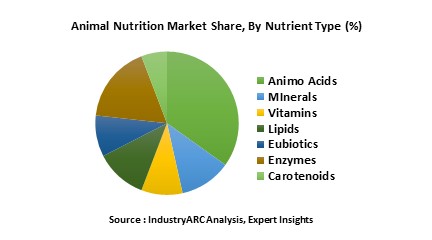

Animal nutrition market

Animal Nutrition Market Players Perspective:

Some of the key players dominating the global animal nutrition market are Cargill Incorporated, The DOW chemical company, Jubilant life sciences, DSM Company, BASF SE, Archer daniels midland company, Dupont, Alltech, Kemin industries, Adisseo France SAS, Evonik industries, Novozymes and Neutreco N.V.

Nutreco in 2017, completed the acquisition of Hi-Pro Feeds. Following the amalgamation, Nutreco’s collective animal nutrition companies in North America, consisting of Shur-Gain, Landmark and Hi-Pro Feeds, will business under the name Trouw Nutrition.


Animal Nutrition Market Research Scope:

The base year of the study is 2018, with forecast done up to 2025. The study presents a thorough analysis of the competitive landscape, taking into account the market shares of the leading companies. It also provides information on unit shipments. These provide the key market participants with the necessary business intelligence and help them understand the future of the Animal Nutrition Market. The assessment includes the forecast, an overview of the competitive structure, the market shares of the competitors, as well as the market trends, market demands, market drivers, market challenges, and product analysis. The market drivers and restraints have been assessed to fathom their impact over the forecast period. This report further identifies the key opportunities for growth while also detailing the key challenges and possible threats. The key areas of focus include the various nutrients in Animal Nutrition Market, and their specific biological uses.


Animal Nutrition Market Report: Industry Coverage

By Species: Aquaculture, Poultry, Ruminants, Swine, Pet, Equine

By Nutrient: Carotenoids, Eubiotics, Vitamins, Enzymes, Minerals, Lipids, Cereals, Carbohydrates

By Administrative method: Oral, Topical, Injection

By End-user: Farms, Households, Veterinarians, Zoos, Animal shelters


The Animal Nutrition Market report also analyzes the major geographic regions for the market as well as the major countries for the market in these regions. The regions and countries covered in the study include:

  • North America: The U.S., Canada, Mexico
  • South America: Brazil, Venezuela, Argentina, Ecuador, Peru, Colombia, Costa Rica
  • Europe: The U.K., Germany, Italy, France, The Netherlands, Belgium, Spain, Denmark
  • APAC: China, Japan, Australia, South Korea, India, Taiwan, Malaysia, Hong Kong
  • Middle East and Africa: Israel, South Africa, Saudi Arabia

"We also publish more than 100 reports every month in “Food and Beverage”, Go through the Domain if there are any other areas for which you would like to get a market research study."


Animal Feed Additive Market - Forecast(2020 - 2025)

Posted in , , , , , , , , ,

 Animal Feed Additive Market Overview:


According to the Food and Agriculture Organization (FAO), livestock contributes to 40% of the global value of agricultural output.[1] The abundance of livestock in the agricultural sector has created a demand for animal feed. However, there are times when there is a discernible dearth of nutrient supply for farm animals which becomes detrimental to their growth. This is leading to an augmented need for animal feed additives that are more often than not used as nutrient supplements in animal feed. The flourishing animal feed additive market was valued to be $25,126 million as of 2018, and the demand for the same is poised to grow with a modest compound annual growth rate (CAGR) of 3.8% during the forecast period of 2019 to 2025.
 
Owing to the population density in APAC and the catapulting demand for the livestock, the animal feed additive market is booming in the region. Furthermore, countries such as China, India, Indonesia, and others have a fairly large market share in the food and agricultural sector. There is also a palpable improvement in the production facilities and risk-management in the livestock sector that includes an increase in the production of animal feed which has opened a myriad of opportunities for the vendors that manufacture animal feed additives. APAC had a regional animal feed additive market share of 37% in 2018. 

                        
Animal Feed Additive Market Outlook:

Animal feed additives include vitamins, amino acids, fatty acids, and minerals. These animal feed additives not only provide the vital animal nutrition to the farm animals but also influence their presentation, hygiene, digestibility, and effect on the intestinal health, thereby producing better meat products for consumption. 
 
According to the recent statistics by PoultryHub, the global poultry production was gauged to be 111,000 thousand metric tons in 2015, and it is going to increase by 24% in the next decade that will translate to 131,255 thousand metric tons in 2025.[2] Furthermore, it is projected to dominate the additional meat production market. Evidently, the future foresees propitious prospects in the poultry industry with a lot of scope for the vendors to boost their animal feed additive market revenue. The application of animal feed additives in the poultry segment is estimated to observe a CAGR of 4.5% through to 2025. 
 
Animal Feed Additive Market Growth Drivers:

  • The Prevalent Nutritional Deficiency in Farm Animals – 
An enormous number of animals suffice the nutritional needs of the world population. However, these animals are more often than not under-nourished and lack proper nutrition supply. This leads to a gamut of nutritional diseases that culminate to deaths of farm animals and the subsequent loss of the food sources. Evidently, the world observes massive food losses. FAO documents the yearly food losses to be one-third of the total food produced which is approximately 1.3 billion tons.[3] This partly attributes to the loss of livestock that suffers from malnutrition. To ameliorate this, it has become imperative for farm owners to inculcate animal feed additives in the diet of livestock which is creating the animal feed additive market revenue avenue for the vendors.
 
  • The Growth of the Veterinary Medicines Market – 
There has been a perceptible growth in the veterinary medicines and vaccines industry for some years now. According to a business intelligence report by IndustryARC, the veterinary vaccines market had a market size of $7.5 billion and is projected to grow with a CAGR of a healthy 8.2% through to 2025. Apparently, the veterinary medicines are ingrained with the animal feed additives in order to suffice the nutritional needs of animals which is significantly driving the animal feed additive market growth.

 
  • The Concerns Pertaining to the Quality of Meat – 
There is a growing concern about the marbling score – a yardstick used to assess the quality of meat. This is largely attributed to the malnutrition in farm animals which is leading to a gamut of diseases, and is also having a subsequent effect on the quality of meat consumed by the population which in turn leads to chronic diseases in humans. With the world in dire need of reducing the people suffering from chronic diseases, there is a demand for good-quality meat which is achieved by fortifying the farm animals with nutrition, and that is prompting a demand influx in the animal feed additive market. 
 
Animal Feed Additive Market Trends:

  • The Trend of Animal Feed Additives Combination – 
Already, a large part of producers is using more than one feed additive. Using feed additives in combination is found to be more beneficial to the health of farm animals. This practice is poised to grow continually during the forecast period which will aid to prospects in the animal feed additive market.
 
  • Data Tracking for Livestock Health – 
The producers will not be using data to check the health of livestock and what exactly needs to be done in order to produce the best quality meat. This will help them identify the kind of animal feed additives to include in the animal feed that can improve the quality of meat.
 
  • The Growing Business Opportunities the Animal Feed Additives – 
In September 2018, Feed Additives Europe had conducted an industry event for the specialty feed additives. The organization is going to organize a similar event this year. This is not only going to spread awareness about the growing animal feed additive market but will also create a myriad of business opportunities for the attendees.
 
Animal Feed Additive Market Challenges:

The major challenge faced by the vendors in the animal feed additive market is the fact that some of the animal farm owners are compromising on the nutrition and managing with just maize, wheat, and barley without nutritional ingredients. This is significantly dwarfing the animal feed additive market size. However, there is a growing awareness about the health benefits of feed additives, which is sustaining to the demand. Another challenge is the veganism wave which is reducing the consumption of animal products and therefore, the demand for animal feed additives. Even though there are people who are opting for veganism, the meat demand is going to make up for a sustainable marketplace for the vendors.  


Animal feed additive market

Animal Feed Additive Market Key Players Perspective: 

The key players crusading for the animal feed additive market share are Cargill, Incorporated, Chr. Hansen A/S, E. I. du Pont de Nemours and Company, Lallemand Inc., Lesaffre, Nebraska Cultures, Inc., Novozymes A/S, Novus, AFB International, and Alltech.
 
Animal Feed Additive Market Research Scope: 

The base year of the study is 2018, with forecast done up to 2025. The study presents a thorough analysis of the competitive landscape, taking into account the market shares of the leading companies. It also provides information on unit shipments. These provide the key market participants with the necessary business intelligence and help them understand the future of the animal feed additive market. The assessment includes the forecast, an overview of the competitive structure, the market shares of the competitors, as well as the market trends, market demands, market drivers, market challenges, and product analysis. The market drivers and restraints have been assessed to fathom their impact over the forecast period. This report further identifies the key opportunities for growth while also detailing the key challenges and possible threats. The key areas of focus include the specific applications of animal feed additives in farms, households, veterinarians, zoo, and animal shelters.  
 
Animal Feed Additive Market Report: Industry Coverage 

The report analyses the product demand of animal feed additive market by species that include aquaculture, poultry, ruminants, swine, pets, and equine. It also analyses the market by the type of animal feed additive zoo technical additives, nutritional feed additives, sensory feed additives, coccidiostats and histomonostats, sugar based products, and direct fed microbial. 

The animal feed additive market report also analyzes the major geographic regions as well as the major countries in these regions. The regions and countries covered in the study include:


  • North America: The U.S., Canada, Mexico
  • South America: Brazil, Venezuela, Argentina, Ecuador, Peru, Colombia, Costa Rica
  • Europe: The U.K., Germany, Italy, France, the Netherlands, Belgium, Spain, Denmark
  • APAC: China, Japan, Australia, South Korea, India, Taiwan, Malaysia, Hong Kong
  • Middle East and Africa: Israel, South Africa, Saudi Arabia

"We also publish more than 100 reports every month in “Agriculture”, Go through the Domain if there are any other areas for which you would like to get a market research study."