Welcome Message

twitter

Follow on Tweets

Energy & Utility Analytics Market - Forecast(2021 - 2026)

Posted in

 Energy and Utilities analytics are used by companies to track the power consumption of their consumers using technology. The introduction of smart meters and smart grids have enabled energy and utilities providers to allocate services efficiently and minimize costs. The advancement in technology coupled with ever-growing demand for power the energy and utilities analytics market is expected to grow at an assumed CAGR of 13.5% during the forecasting period 2018-2023. Increasing environmental awareness, rising costs and the need for transparency propelled energy and utilities companies to utilize energy smartly.


What is Energy and Utility Analytics? 
Energy and Utilities analytics is the implementation of technology to analyze and provide resourceful insights using the data collected. Until a few years ago, energy and utilities providers applied a traditional single data point system i.e. using a meter to monitor power consumption. Smart meters and smart energy grids have revolutionized the ways information is collected and utilized.  Using these devices data such as utility consumption of water, electricity and waste & recyclables, the peak hours of usage, power shortages and fluctuations, and interactive services are collected and transferred. The major industries where analytics have high potential are Oil, Gas, Electricity, Coal, Nuclear, Renewables and Others.
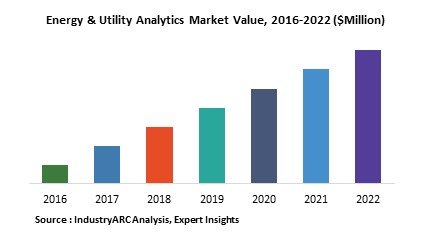

 Energy & Utility Analytics Market

Market Research and Market Trends of Energy and Utilities Analytics Market 
  • Top level CEOS and industry leaders are increasingly adopting analytics in their daily business operations. Environmental awareness and increasing costs are terms which are heard on a regular basis in this industry. To combat these issues companies are ditching traditional methods and are increasingly opting for smart devices. Major players use analytical tools such as big data, predictive, descriptive, diagnostic and prescriptive to evaluate trends and obtain actionable information.
  • The EnergyIP Analytics Suite service introduced by Siemens helps consumer’s access energy efficiently and effectively. The company uses a metering system and an app to record all the important energy data from their sources. Smart meters and smart energy grids record and transfer data regularly to service providers. With the help of excellence teams and analytics companies are able to understand consumer usage patterns, forecast demand, maintain energy constraints more efficiently, check upon fraud, minimize losses and enhance customer services. Also, many companies are providing full-fledged home automation services, a system is installed at home to track and remotely control all the devices at home. Users can access all appliances from their smartphones and either turn on or turn off depending on their usage without being physically present.

Who are the Major Players in Energy and Utilities Analytics Market?
The key players in the market are ABB, Capgemini, CA Technologies, IBM, Oracle, SAP, SAS, Siemens, Heliopower, Schneider Electric and many others.

What is our report scope?
The report incorporates in-depth assessment of the competitive landscape, product market sizing, product benchmarking, market trends, product developments, financial analysis, strategic analysis and so on to gauge the impact forces and potential opportunities of the market. Apart from this the report also includes a study of major developments in the market such as product launches, agreements, acquisitions, collaborations, mergers and so on to comprehend the prevailing market dynamics at present and its impact during the forecast period 2018-2023.

All our reports are customizable to your company needs to a certain extent, we do provide 20 free consulting hours along with purchase of each report, and this will allow you to request any additional data to customize the report to your needs.


Key Takeaways from this Report
  • Evaluate market potential through analyzing growth rates (CAGR %), Volume (Units) and Value ($M) data given at country level – for product types, end use applications and by different industry verticals.
  • Understand the different dynamics influencing the market – key driving factors, challenges and hidden opportunities.
  • Get in-depth insights on your competitor performance – market shares, strategies, financial benchmarking, product benchmarking, SWOT and more.
  • Analyze the sales and distribution channels across key geographies to improve top-line revenues.
  • Understand the industry supply chain with a deep-dive on the value augmentation at each step, in order to optimize value and bring efficiencies in your processes. 
  • Get a quick outlook on the market entropy – M&A’s, deals, partnerships, product launches of all key players for the past 4 years.
  • Evaluate the supply-demand gaps, import-export statistics and regulatory landscape for more than top 20 countries globally for the market. 

  •  

Remittance Market - Industry Analysis, Market Size, Share, Trends, Application Analysis, Growth And Forecast 2021 - 2026

Posted in


Remittances Market overview:

International money transfer is commonly referred as 'remittances’. As per the World Bank, global remittances reached an unprecedented value of $689 billion in 2018, an upward drift from $633 billion recorded in 2017. Some factors responsible for the growth in global remittances are: increasing migrating population to developed countries, pressure from the United Nations to lower transfer fees, bourgeoning FinTech and mobile payments technology, and increasing numbers of non-bank remittance vendors such as MoneyGram and Western Union. Resultantly, the global remittance market size was estimated as $1.74 billion in 2018, with growing refugee population and rampant urbanization, the market is progressing at a CAGR of 19.56%, during the forecast period 2019-2025.

Remittances Market Outlook:

In 2018, North America was reckoned to be the leading region with an estimated market share of 33.81% of the global market. Increasing number of immigrants settling in the U.S. for several purposes such as education and employment are some pivotal factors supporting regional dominance. According to the Migration and Development Brief by the World Bank Group, in April 2018, the number of migrants globally was estimated to be 266 million, with the U.S. alone accounted around 43 million immigrants. Similarly, according to the findings by the Pew Research Center, remittance outflow from the U.S. was recorded to be $148.4 billion in 2017, with inflows calculated to be $6.6 billion for the same year. The U.S. with its affluent economy and industrial sector is a lucrative international center for enterprises to expand towards. Therefore, there is a recurring demand for workforce, inviting employees from all across the globe creating intense remittance market demand.

Although, personal remittance has a major share among the end-user verticals, business remittance is figured to be the fastest growing segment progressing with a CAGR of 33.81% through to 2025. Globalization has enabled enterprises to develop their fronts and expand internationally, resulting in an upsurge of across border investments, especially in developing countries with untapped opportunities. For instance, developing economy of India is the leading remittance recipient globally with a value of $79 billion (+10% from 2017) in 2018.

Remittances Market Growth Drivers and Trends:

· Support from the World Bank in a form of mobilizing funds on migration, to support migrants with an objective of eradicating poverty is a major factor disrupting the global remittance market size. Moreover, migration-related Sustainable Developments Goals such as reducing transaction fee from 7.1% in 2018 to 3% by financial institutions will enable migrants for efficient transfers, augmenting the market share. Also, with declining fee, money transfer operators (MTO) are offering novel services such as virtual bank accounts and prepaid debit cards to carve a niche for themselves, hence increasing traffic in the market to leverage such services.

·         · Substantial progressions and rampant developments in the global mobile payments and Fin Tech market are being profitably capitalized by the remittance market vendors. With the advent of mobile payment services, a nuance of transparency is added, as transaction can be initiated by user itself through a smartphone. This benefits the user with utmost privacy and security, which is a major factor attracting remittance senders towards utilization of these modern services.

· As the United Nations is portraying severe stance on diminishing transaction fee, instant remittance is a major trend disrupting the market with competitive charges of 0.5% of the transaction amount on limited amounts, and transparency in opaque market of international money transfers. InstaRem and Peer Transfer are some global vendors providing instant remittance services. Tracing escalating number of students migrating to different countries for education, such economic services on limited amounts are capable of dominating major shares in the market.

Remittance Market Companies:

Some players with substantial market share in the remittance market are WorldRemit Ltd., InstaReM, Ria Financial Outward Remittance, Azimo Ltd., TransferWise Ltd., WorldRemit Ltd., Banco Bradesco Sa, Euronet Worldwide, Inc., Societe Generale, Xoom Corporation and The Kroger Co., and SingX Pte Ltd.

Mergers and acquisitions are predominant strategies adopted by the market players. For instance, Xoom was acquired by PayPal in 2015 for $890m that turned out to be an example of successful exit for investors in the global remittance market.

Remittance Market Research Scope:

The base year of the study is 2018, with forecast done up to 2025. The study presents a thorough analysis of the competitive landscape, taking into account the market shares of the leading companies. It also provides information on unit shipments. These provide the key market participants with the necessary business intelligence and help them understand the future of the Remittance Market. The assessment includes the forecast, an overview of the competitive structure, the market shares of the competitors, as well as the market trends, market demands, market drivers, market challenges, and product analysis. The market drivers and restraints have been assessed to fathom their impact over the forecast period. This report further identifies the key opportunities for growth, while also detailing the key challenges and possible threats. The key areas of focus include the various types of developments in global Remittance Market, and their specific advantages to the market.

Team Collaboration Software Market - Industry Analysis, Market Size, Share, Trends,Application Analysis, Growth and Forecast 2021 - 2026

Posted in

 Overview

The market for Team Collaboration Software is forecast to reach $18.45 billion by 2025, growing at a CAGR of 11.4% from 2020 to 2025. Increasing need to share and digitize visual data provides an opportunity for business development. Integrating web conference applications with other communication tools improves collaboration solutions' flexibility and provides the ability to effectively communicate among participant participants. Additionally, organizations have started realizing the benefits of leveraging affordable video conferencing solutions, which is facilitating wide-scale adoption of team collaboration software.


Report Coverage
The report: “Team Collaboration Software Market– Forecast (2020-2025)”, by IndustryARC covers an in-depth analysis of the following segments of the Team Collaboration Software Market. 

By Delivery Model – On-premise, SaaS
By Vertical – BFSI, Communications & Media, Manufacturing, Government, Healthcare, Wholesale & Retail, Services, Transportation, Utilities & Resources, Others
By Geography - North America (U.S, Canada, Mexico), South America(Brazil, Argentina and others), Europe(Germany, UK, France, Italy, Spain, Russia and Others), APAC(China, Japan India, SK, Australia and Others), and RoW (Middle east and Africa)

Key Takeaways
  • North America dominated the global market for team collaboration software, with a share of 38.9% in 2019 attributed to an incrementing trend amongst corporations to increase IT budgets to transform legacy communication systems and enhance employee productivity. 
  • The on premise delivery model segment captured 55.05% revenue share of the team collaboration software market in 2019 as it delivers more secure medium of meeting compliance and data security issues than the SaaS model.
  • The implementation of work from home strategy for continual operational practices, and the subsequent need to collaborate with various team members and other cross-functional teams is providing an impetus to the market growth.
  • The growing use of video conferencing applications offers security challenges for users, which is one of the major obstacles hindering the growth of team collaboration software market.

Delivery Model - Segment Analysis
The on premise delivery model segment captured 55.05% revenue share of the team collaboration software market in 2019, as it delivers a secure medium of meeting compliance and data security issues. On-premise solutions ensure low latency in data transfer rates, which in return aids organizations in practicing cost-effective data management. The adoption of on-premise deployment mitigates the need to invest in expensive internet plans, which offers cost-saving opportunities to organizations and also ensures continual operational practices in cases of a data outage. Such solutions also provide the ability to exercise greater control on server hardware along with flexible customization of storage distribution.


Vertical - Segment Analysis
The market is segmented by vertical into BFSI, Communications & Media, Manufacturing, Government, Healthcare, Wholesale & Retail, Services, Transportation, and Utilities & Resources among Others. The Communications & Media segment dominated the market in 2019. The increased need for efficient coordination among team members during the lockdown period is creating lucrative team collaboration software market growth opportunities in IT and communications vertical. Team collaborations are helping organizations to improve productivity, secure document sharing and efficient coordination between departments. Rising adoption of Unified Communication as a Service (UCaaS) amongst IT companies to facilitate efficient communication and collaboration is offering an impetus to the market growth. Telecom companies, including AT&T Inc., have started collaborating with OTT media streaming providers to offer value-added services to their customers, which augments the need to deploy team collaboration software between OTT service providers and the company. Furthermore, rising demand amongst companies in this sector to indulge in video conferencing to facilitate knowledge sharing is also acting as a major driving factor for the market growth.

Geography - Segment Analysis
North America dominated the global market for team collaboration software, with a share of 38.9% in 2019. This can be attributed to an incrementing trend amongst corporations to increase IT budgets to transform legacy communication systems and enhance employee productivity. Enterprises are also increasing IT spend on account of enhanced security measures such as encryption of end-to-end data transfer, and access, which is expected to impact the market growth positively. Additionally, the growing penetration of high-speed internet in several households is facilitating employee flexibility, thereby increasing the demand for this software in the region. Asia Pacific is expected to witness the fastest growth over the forecast period. The growth can be attributed to a rise in several investments in infrastructure, cloud service providers, and smartphone users. Rapid industrialization in countries, such as India and Japan, due to improved government initiatives such as the Make in India and Startup India initiatives, and the new immigration bill passed in Japan in 2018; is further augmenting the need to develop efficient team collaboration systems. Additionally, changes in FDI policies in countries such as Singapore, Indonesia, and India are promoting corporations to open up centers in these regions, which facilitate the need to deploy effective collaboration solutions on an organizational scale.
 
Drivers – Team Collaboration Software Market
  • Advent of 5G Delivery Model
One of the major factors that has boosted the adoption of team collaboration is the advent of 5G delivery model. Rising demands of clients and increasing remote workforce facilitate the requirement to be connected and be productive, which can be achieved by leveraging 5G technology. The provision of high-speed internet offers the ability to indulge in seamless video conferencing, superior VoIP experience, and faster data processing and transfer rates. Organizations are preparing to introduce 5G by investing in a flexible network, which can adapt to new collaboration and communications tools. The adoption of upgraded software with 5G capability is expected to trigger the market growth over the next few years.
  • Growing trend among organizations to implement smart meeting rooms 
The growing trend among organizations to implement smart meeting rooms is offering exciting prospects to market growth. Modern and innovative technologies enable corporations to facilitate seamless connectivity amongst their workforce, which boosts productivity, fosters creativity, and gives companies a competitive edge against their peers. Meeting rooms equipped with integrated smart control panels enhance meeting experiences by simplifying and consolidating input commands, which facilitates better user experience and encourages positive collaboration. Furthermore, these tools offer the ability to record meetings for participants to follow up and take points from a previously conducted meeting.
  • Work from Home policy due to emergence of Covid-19 pandemic
The global pandemic, COVID-19 (coronavirus), offers significant growth aspects to the market. Emerging regulations from government bodies to practice social distancing due to the highly contagious nature of the disease has promoted companies to increasingly deploy work-from-home (WFH) business practices. The implementation of these strategies for continual operational practices, and the subsequent need to collaborate with various team members and other cross-functional teams is providing an impetus to the market growth.
 
Challenges – Team Collaboration Software Market
  • Security Issues
Furthermore, the emerging need amongst enterprises and SMEs to conduct video conferences to ensure continual and efficient business processes is further aiding the market growth. However, the growing use of video conferencing applications offers security challenges for users. Rising instances of hacking by individuals with malicious intent deters growth opportunities. Furthermore, a globally slowing economy restricts companies from investing in IT-related infrastructure, which may act as a challenge for industry growth.

Market Landscape
Product launches, acquisitions, and R&D activities are key strategies adopted by players in the Team Collaboration Software Market. Team Collaboration Software driver market is expected to be dominated by major companies such Adobe Systems (The U.S), AT&T (The U.S), Avaya (The U.S), Citrix Systems (The U.S), Cisco Systems (The U.S), YAHOO (The U.S), Smart Technologies (Canada), Unify Software and Solutions GmbH & Co. KG (Germany), Polycom (The U.S), Novell (The U.S), Microsoft Corporation (The U.S), IBM (The U.S), Oracle Corporation (The U.S), Blackboard (The U.S), AudioCodes (TIsrael)  and Radisys (The U.S) among others.


Acquisitions/Technology Launches/Partnerships
  • September 2018 – Astro was acquired by Slack for helping about more than 12M Daily Active Users (DAU) and over 100k paid customers by simplifying the job of moving conversations from an email into Slack. The company is planning its strategic acquisition for improving the regular customer experience in terms of slack application.
  • July 2019 –A new Unified Communications (UC) product, namely Grasshopper Connect, was launched by LogMeln, Inc. This product is designed for providing all types of business communications in a single and easy-to-use application format to small businesses. This will further help to strengthen the Unified Communications portfolio on the one hand and help business management easier for small companies on the other.

FinTech Market - Forecast(2021 - 2026)

Posted in


Fintech Market Overview

The market for Fintech is forecast to reach $161.2 billion by 2026, growing at a CAGR of 8.7% from 2021 to 2026. Artificial Intelligence (AI) has taken the tech world by storm, allowing companies to automate their high-value and complicated processes. The reason to make a shift towards machine learning is also motivated by reduction in cost, increasing efficiency, reducing error and better customer experience through improved digital lending, automated insurance and personal finance solutions. The Fintech is majorly driven by credit card fraud detection. With the help of Generative Adversarial Network, Artifical Intelligence can spot the difference between real data and hacked data in each transaction and send alert to banks. The biggest challenge with fintech is the sensitive issue of data privacy and security, which most fintech companies are facing. The fintech sector is governed by strict compliance to regulations and governance since any data breach or security failure could be disastrous.

Report Coverage

The report: “Fintech Market– Forecast (2021-2026)”, by IndustryARC covers an in-depth analysis of the following segments of the Fintech Market.
By Services : Payments, Fund Transfer, wealth Management, personal Loans and P2P Lending, Insurance, personal Finance and others
By Technology : AI, Blockchain, Analytics, Mobile Commerce, Cyrptography, Cloud Infrastructure, Biometrics, RPA, Cyber Security and Others
By Application : Retail Banking, Investment Banking, Hedge Funds, Stock Trading Firms and Others
By Geography : North America (U.S, Canada, Mexico), Europe (Germany, UK, France, Italy, Spain, Russia and Others), APAC(China, Japan India, SK, Australia and Others), South America(Brazil, Argentina and others), and RoW (Middle east and Africa).

Key Takeaways

  • Advent of technology is bringing up a new breakthrough every now and then and AI has certainly changed the way of data collection, data integration, analysis and deployment.
  • As far as financial technology is concerned, the trend of these “robo-advisors” has brought in a drastic improvement in customer interaction and customized revenues.
  • Systems such as chatbots, voice systems, and text chats are designed to replace the human intervention while being cost efficient. They are even intended to recognize and prevent fraud attempts. On the other hand, automated financial assistants and planners became handy in monitoring events and help customers in making financial decisions.

Fintech Market, By Region, 2020
Fintech Market
For More Details on This Report - Request for Sample

Fintech Market Segment Analysis - By Service

In FinTech sector transaction type segment discuss about the payments, financial institution and insurance. Insurance occupied the largest market share in 2020 at 16.5%. The use of FinTech technology across the financial services industry is growing. Emergence of services such as PayTech, RegTech, InsurTech, and digital banking highlight the ways in which digitalization has impacted the FinTech industry. These consumer demand in improved access and anytime anywhere services is achieving greater transparency and will lead the market in the period of 2021-2026.

Fintech Market Segment Analysis - By Technology

AI is the fastest growing segment at 21.6% through 2026. AI can be used to find the relation between world events and their impact on prices by using predictive analysis. This information is very useful for any kind of wealth investment. AI in financial services are used to protect the details of their customer. AI is playing major role by quickly assessing the large algorithms to protect from fraudulent cases. AI is used to advise the accurate result. P2P organization analyze their potential customer’s behavior and detect all the risk in the cooperation with that particular customer.AI also helps in analyses consumer’s details who doesn’t have past credit history or his credit history is destroyed. This growing list of applications will be the major driver of adoption of AI in Fintech sector. Another application driven by new technology developments has been robo advisors. Robo- advisor keep monitoring on the events, stocks, bond and price trend according to user’s requirement which help them in making suggestion regarding which stock needs to be sell or buy. They play very important role in risk management, speech recognition, network security access to big data etc. These technology developments will create new avenues of opportunity for Fintech thereby driving the market growth.

Fintech Market Segment Analysis - By Geography

APAC region holds the largest market share in the Fintech Market at 34% in 2020. However, Asia Pacific is also set to witness highest growth during the forecast period. North American Fintech Market is mainly driven by the large number of startups and emerged companies offering AI services to financial services. The key applications include Virtual Assistant, Business Analytics & Reporting, Customer Behavioral Analytics among others.

Fintech Market Drivers

Focus of Companies on Cost Reduction and Improving Efficiency

Fintech is allowing companies to cut down their cost, automate their process and reduce the chances of error. AI Chatbots are used by companies as customer assistants for various purposes such as sales, customer care executive (over phone), and online chat executive. AI is empowering small finance companies as it is affordable as well as chances of error occurrence is very low. In addition, the insightful details about the cash flow and income and expense is gaining the traction from the end user as this helps companies to reduce their expenses.

New Technological Advancements drives Adoption of Fintech

According to McAfee cybercrime currently costs the global economy around $600 billion, or 0.8% of global GDP. One of the biggest cybercrimes is credit card fraud. Thus companies are designing a new generation of algorithms that are Convolutional Neural Networks and are based on the visual cortex, which is a small segment of cells that are sensitive to specific regions of the visual field in the human body. This means that they are able to extract elementary visual features like oriented edges, end-points and corners. This technology can study the spending data of an individual and be able to determine, based on this information, whether they performed the most recent transaction on their credit card or if someone else was using their credit card data.

Fintech Market Challenges

Concerns Regarding Data Privacy

The biggest challenge with technology adoption in fintech is the sensitive issue of data privacy and security, which most fintech companies are facing. The fintech sector is governed by strict compliance to regulations and governance since any data breach or security failure could be disastrous. Privacy concerns are cropping up as companies feed more and more consumer and vendor data into advanced technologies whether it is analytics, AI or blockchain to create new bits of sensitive information, unbeknownst to affected consumers and employees. This is especially prevalent in the retail banking sector, where consumer data collection has been at the forefront in terms of big data challenges. These data privacy concerns will hinder the adoption of AI especially in banking sector.

Fintech Market Landscape

Product launches, acquisitions, and R&D activities are key strategies adopted by players in the Fintech Market. Microsoft, Google, IBM, Intel, Affirm, Upstart, Sigmoidal, Zest Finance and Amazon are considered to be the key players of the Fintech Market.

Acquisitions/Technology Launches/Partnerships

  • In May 2021, Healthcare Fintech Cedar announced a $425 million acquisition of San Francisco-based OODA Health for a mix of cash and equity. The move was fueled by a $200 million Series D cash injection in March led by Tiger Global Management
  • In May 2021, Corporate finance software provider Bill.com LLC has signed a $2.5 billion deal to acquire DivvyPay Inc., better known as Divvy, whose cloud service enables companies to issue business credit cards to their employees.

Related Reports

Report Code: ITR 0221

Report Code: ITR 28984

For more Information and Communications Technology related reports, please click here

Hadoop Market - Forecast(2021 - 2026)

Posted in

 The Hadoop market is expected to grow at a CAGR of 48 % during the forecast period. Many small and large enterprises has learned the benefit of employing Hadoop. Hadoop is playing an important role in Big Data analytics. This report gives a detailed information about the Hadoop market, components, tools associated with Hadoop and the roles played by different components of Hadoop in market to keep it most preferred analytical tool till date.   


What are Hadoop Market?

Hadoop is an open source software platform developed by Apache Software Foundation for scalable and distributed computing of large volume of data. It provides high performance and cost effective analysis of Big Data generated by the enterprises through digital platforms. Big Data is large amount of data set whose size or type is beyond the ability to be processed traditionally. It consist of three types of data sets namely saturated data, Semi-structured data and unsaturated data. Big Data comprises of three main components such as volume, velocity and variety. Data sets corresponds to the contents of single database table or single statistical data matrix. It can be in Terabytes and Petabytes. In Hadoop market, the enterprises use Hadoop’s open source component to store, process and analyze the large amount of data generated through digitally to remain, competent in market as well as forecast the market with end users to increase the business activity. 

What are the applications of Hadoop Market?

Hadoop is an open source platform which can perform operation on large files stored in distributed file system which is capable of managing all types of data. The application of Hadoop market are Banking, Transportation, Healthcare, Communication and others.


Hadoop Market

Market Research and Market Trends of Hadoop:

  • Apache Hadoop is an open source of framework written in Java which allows operation on large datasets stored in distributed file system. The data generated extremely in large quantity from single or multiple sources at high pace is known as Big Data. Big Data represents next generation in data analytics and visualization. It provides the organization with large amount of data sets which can be used for analysis, Optimization and implementation of new strategy to move to next level. Hadoop consist of four main components such as MapReduce, HDFS, Hadoop common and Hadoop YARN. As the name suggest MapReduce does mapping of the data where  the data set is broken down into value pairs and then that data is passed on to reduce where the output from map task is further broken down in value pairs and reduce task was performed. The Hadoop distributed file system (HDFS) which allows the data to be stored in accessible format across large number of linked storage devices. Hadoop common is a set of services used by other Hadoop components. YARN manages the resources of the systems storing the data and running the analysis. 
  • Development of Hadoop began to store and analyze large amount of data sets which can practically store and accessed on one physical storage devices. The virtual storage of data has been in context such as cloud storage. Apache Spark and Flink are the two processing engine run by YARN. Out of these two Spark runs both batch and real time workloads by ousting the MapReduce in many batch applications and it can bypass the HDFS to access the data from Simple storage service (S3) in AWS cloud. The tools associated with Hadoop are Flume, HBase, Hive and others which can run along the Hadoop and have achieved the Apache project status. Hadoop is compatible with operating system such as Linux/GNU but if the enterprise doesn’t of Linux/GNU operating system they can use virtual box software by inducting Linux inside it. There are different analytical tools are present in the market for analyzing the data sets but the thing which is making Hadoop more preferred is of being open source and providing all analytics at one platform.  
  • One of the current trend in the Hadoop market is usage of Hadoop in Elastic cloud compute infrastructure, Machine learning, Data Lake and Data Fabric. Elastic cloud compute is a platform upon which the Amazon web services own version of Apache Hadoop, Elastic MapReduce works for analyzing the data set. The thing which makes it trend is it can support the Apache Hadoop analytics software. The Data Fabric simplifies and integrates the data management across cloud and on premise. It consistently delivers and integrate the hybrid data cloud services for data insight, access, control, protection and security.

  • Inquiry Before Buying
  •   

Who are the Major Players in Hadoop Market?

The companies referred in the market research report are SAS, Cloudera, Teradata partnership Organization and 10 other companies.

What is our report scope?

The report incorporates in-depth assessment of the competitive landscape, product market sizing, product benchmarking, market trends, product developments, financial analysis, strategic analysis and so on to gauge the impact forces and potential opportunities of the market. Apart from this the report also includes a study of major developments in the market such as product launches, agreements, acquisitions, collaborations, mergers and so on to comprehend the prevailing market dynamics at present and its impact during the forecast period 2018-2023.

All our reports are customizable to your company needs to a certain extent, we do provide 20 free consulting hours along with purchase of each report, and this will allow you to request any additional data to customize the report to your needs.

Key Takeaways from this Report

  • Evaluate market potential through analyzing growth rates (CAGR %), Volume (Units) and Value ($M) data given at country level – for product types, end use applications and by different industry verticals.
  • Understand the different dynamics influencing the market – key driving factors, challenges and hidden opportunities.
  • Get in-depth insights on your competitor performance – market shares, strategies, financial benchmarking, product benchmarking, SWOT and more.
  • Analyze the sales and distribution channels across key geographies to improve top-line revenues.
  • Understand the industry supply chain with a deep-dive on the value augmentation at each step, in order to optimize value and bring efficiencies in your processes. 
  • Get a quick outlook on the market entropy – M&A’s, deals, partnerships, product launches of all key players for the past 4 years. 
  • Evaluate the supply-demand gaps, import-export statistics and regulatory landscape for more than top 20 countries globally for the market.


For more Information and Communication Technology related reports, please click here